Ethereum continues to reverse a long-standing model of the tension between the cost of execution and data storage.
This post is also published on Medium.

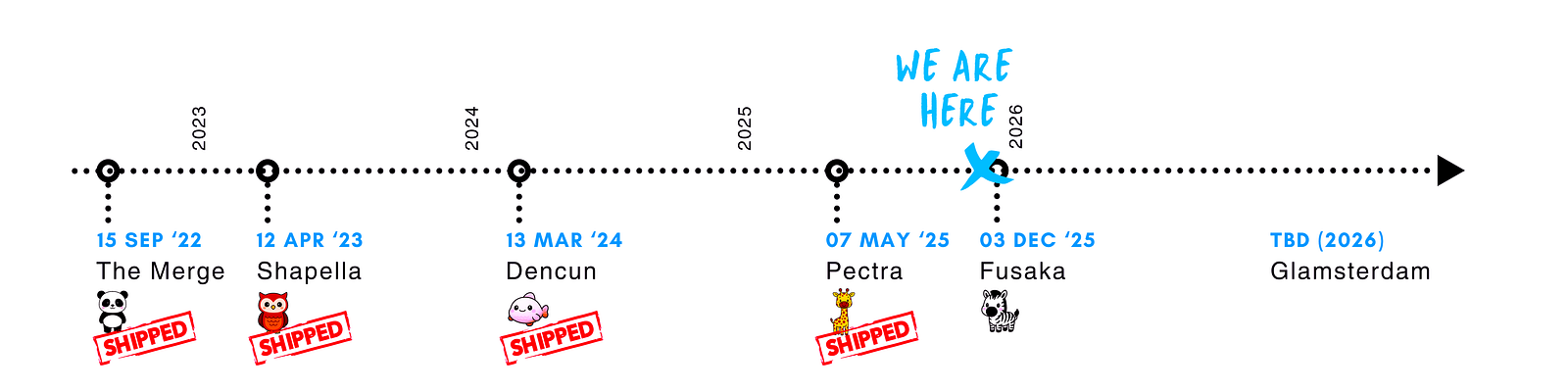
Another Ethereum hard fork is upon us. The Fusaka (Fulu/Osaka) upgrade went live this week. It is the second for 2025, after Pectra which activated earlier this year in May. For Pectra, many highlighted its inclusion of EIP-7702, a transformative update for account abstraction that integrates wallets with a contract-based specification. EIP-7702 enables a variety of programmable possibilities like transaction bundling and account recoverability.
Fusaka itself is packed with upgrades. This post highlights a few of the most prominent. I focus on three themes: (i) blob scaling, (ii) L1 scaling and (iii) a major and perhaps under-appreciated upgrade that may transform the interface between Ethereum and mainstream adoption.
A theme across many upgrades is continuing a major shift in cost model. Early in Ethereum’s history, the protocol assumed data should be free and easy to store and transacting more fee-adjusted.
Ethereum’s road map seems to reverse this model — it assumes transacting should be fast and affordable across the ecosystem, while data availability should be more carefully managed.
i. Fusaka Scales Blobs
One highlighted update in Fusaka involves blobs. Blobs are temporary storage structures on mainnet that are used by second layers (L2s) for data availability. EIP-7594 is fondly known as “PeerDAS” (peer data availability sampling) and will require nodes only to verify a subset of all blobs. While each node verifies just a subset, many nodes together can achieve reliable data availability. This lowers demand on storage and so will increase throughput for L2 activity.
Fusaka also includes an update to successively increase the total possible blobs stored on consensus. Currently the number of blobs per block is maxed out at 9 but this number will go to 15 later this month and 21 early in 2026 under Fusaka.
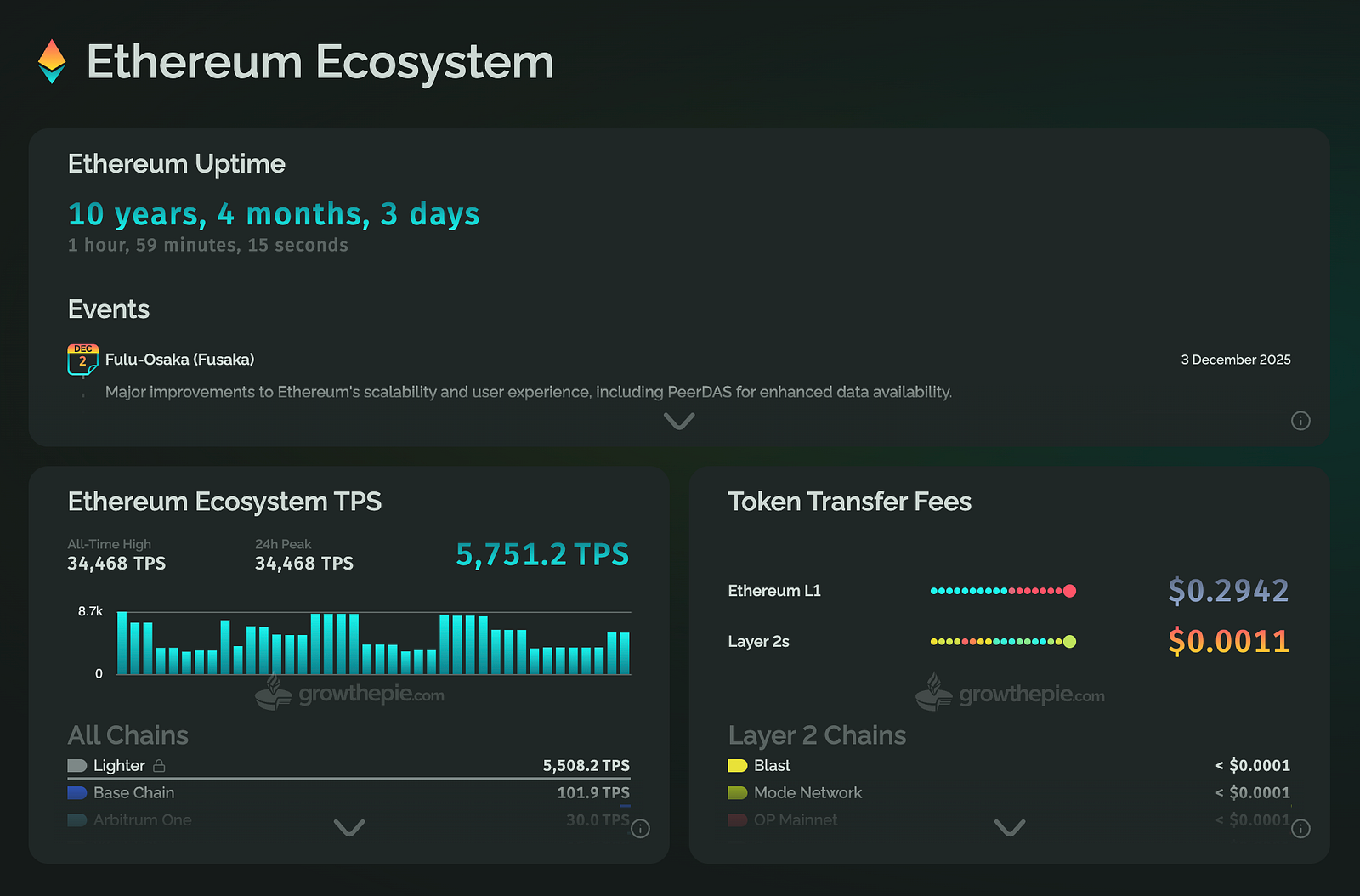
So Fusaka will have measurable impact on L2 throughput. As the weeks go by, we may see this impact through on-chain statistics. Recently, the Ethereum ecosystem in its entirety was estimated to have surpassed the mark of 31,000 transactions per second. These changes to the blob infrastructure seem likely to amplify this further.
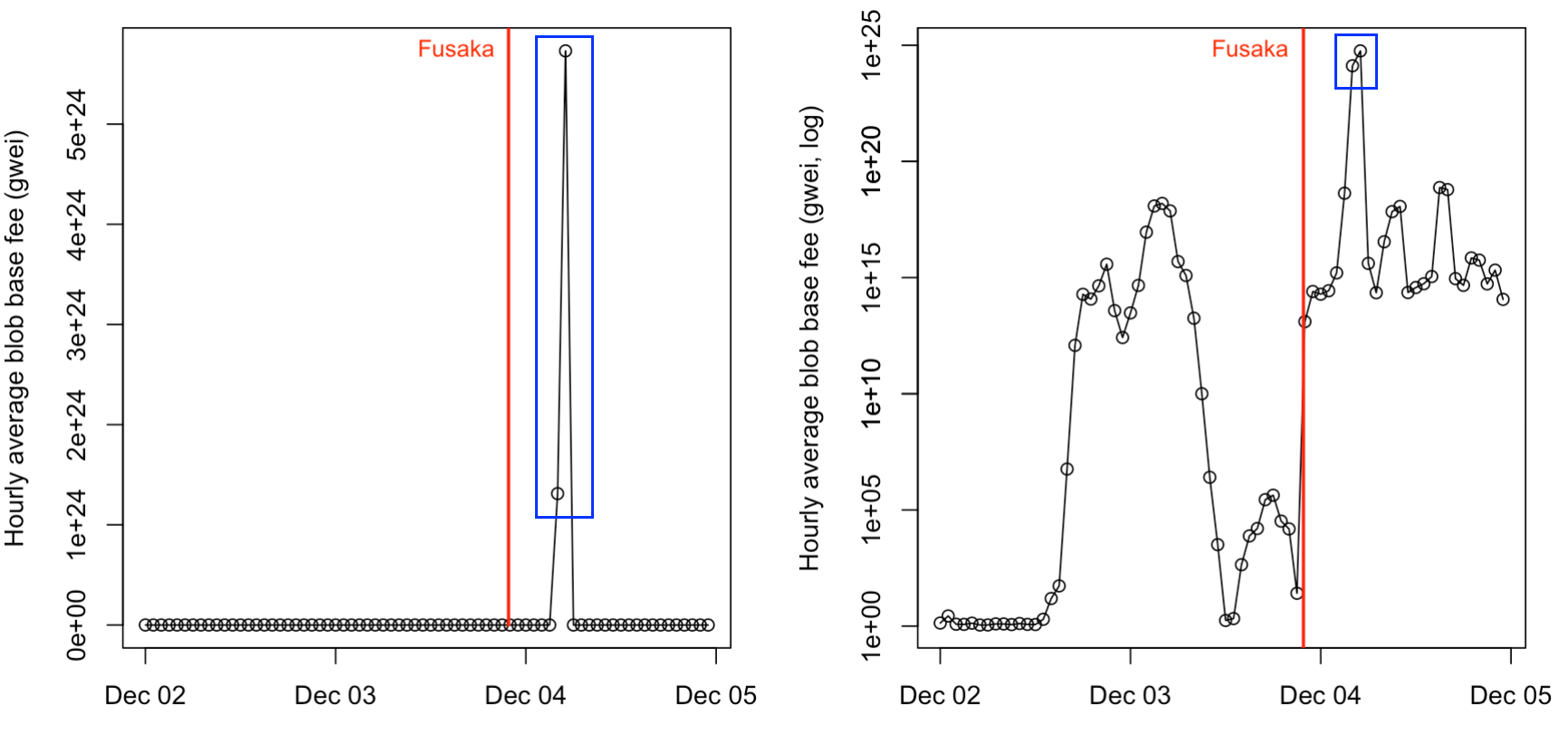
Another important update to mention is that the fee market for blobs was made a bit more expensive with EIP-7918 with the goal of paying for the required execution on mainnet. This now ensures that there is some expense for L2s to use blobs, which before Fusaka were basically free. However it sparked some discussion because blob fees massively spiked after Fusaka.
ii. Fusaka Scales, Protects L1
Some other upgrades relate to scaling mainnet (L1). One of these upgrades happened on mainnet before Fusaka went live: On November 25th, about a week ago, a majority of validators approved an increase to the block gas limit of 60 million. This was part of EIP-7935 and set for Fusaka, but many quickly noticed that this update came sooner with the approval of validators.
Just a year after the community started pushing for higher gas limits, Ethereum is now running with a 60M block gas limit.
— Toni Wahrstätter ⟠ (@nero_eth) November 26, 2025
That’s a 2× increase in a single year — and it’s only the beginning.
H/t to all client teams, the researchers involved, and to @nanexcool and @econoar for… pic.twitter.com/5JB8FoiACP
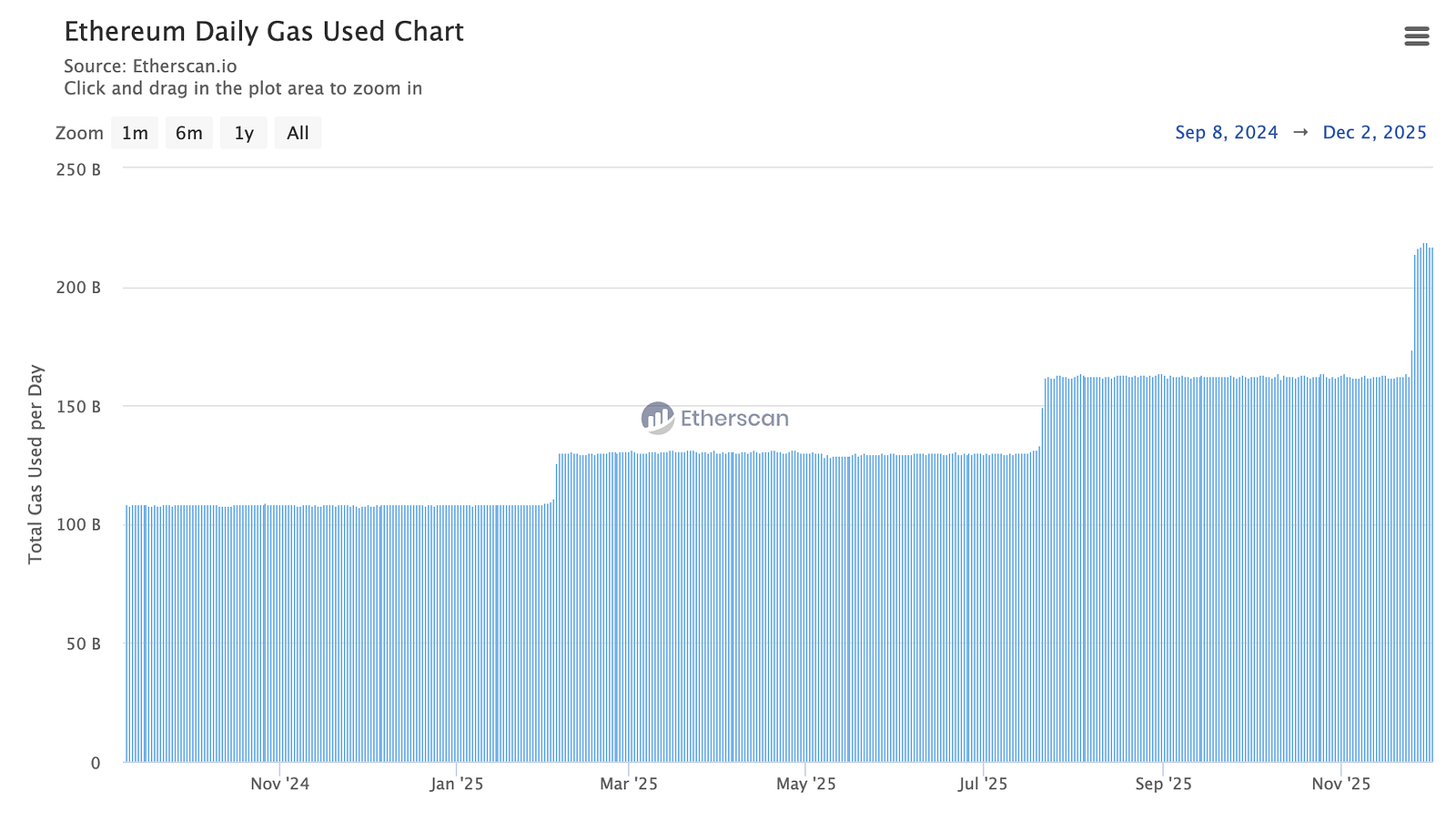
On Etherscan, we see gas usage per block going up on this date as it was settling in. The effective gas limit successively increased from 45 million to 60 million. For example, block 23,880,149 used 59,923,398 gas, almost maxing out the new limit that was set by validators that day.
Another important upgrade in Fusaka is the per-transaction gas limit. With EIP-7825, transactions are now limited to 2²⁴ or about 17 million gas. This can serve as a protective mechanism to avoid denial-of-service attacks.
Transactions at this size are said to be rare, and that’s true. However they do occur. In fact, many wallets associated with high gas usage are related to a particular ERC-20 coin. Massive farming of XEN Torrent coin and other XEN-related tokens often occurs when base fee is low.
Here’s an example transaction that minted many XEN coins to a batch of wallets. It consumed 24,410,592 gas. These contracts are often high on Etherscan’s gas guzzler list:

XEN is not the only source of gas-heavy transactions. Some DeFi transactions are also in this category. For example, this transaction used 40,827,281 gas to conduct a series of swaps. Here’s another that used 42,010,509 to distribute a token to over a 1,000 recipients.
Overall, several such wallets show many transactions with gas consumed at more than 2²⁴ (~16.7 million) gas. This is shown in the graph below. Since June, 2025, over 18,000 transactions exceeded this limit on just 50 addresses that have high-gas per-transaction consumption.
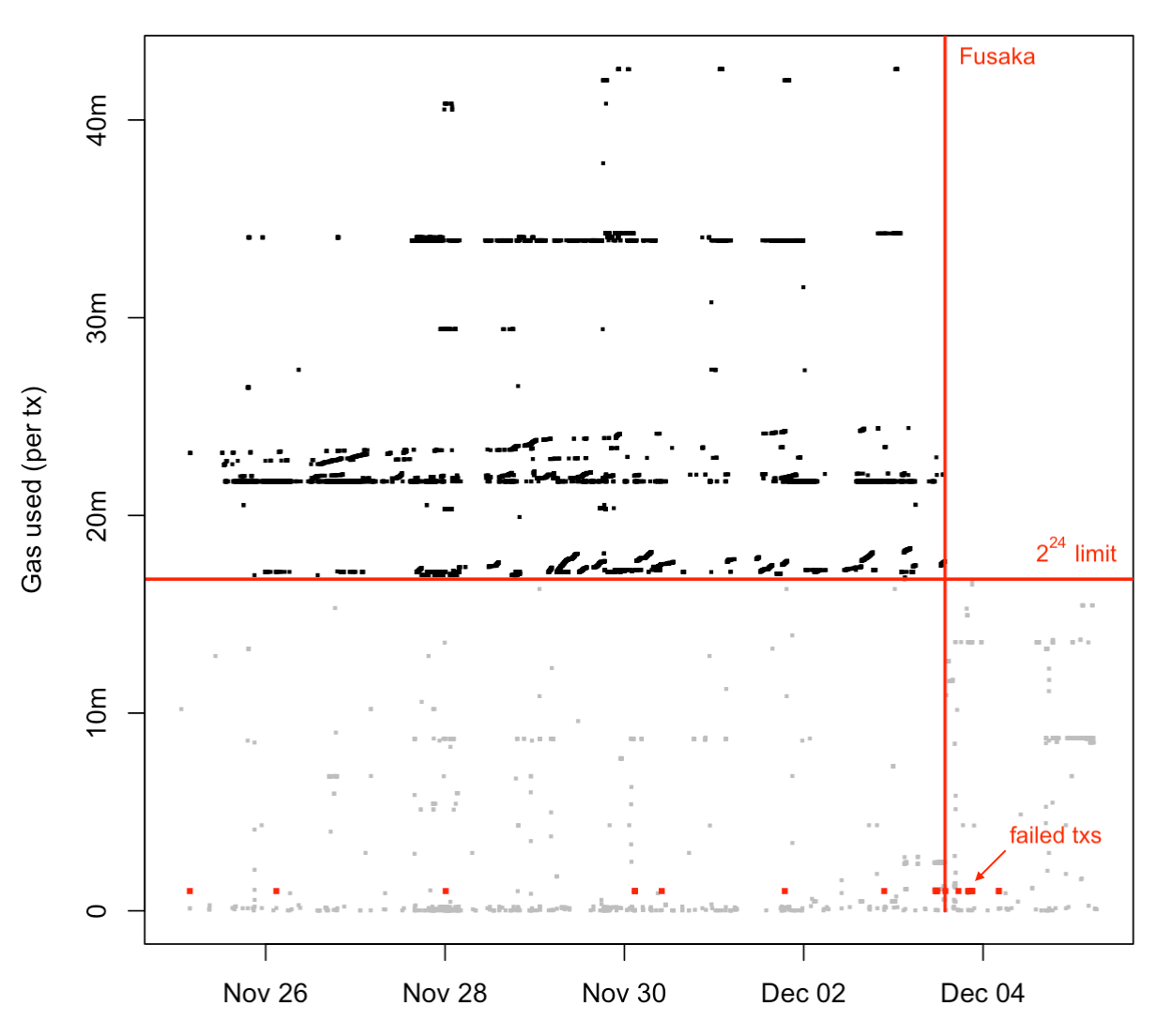
The points in the graph above are “stacked” on top of each other because they are occurring rapidly together as Fusaka approaches.
We can improve the sense of scale in the graph below. In this graph, we slightly shuffle the (x,y) placement of these dots, each a transaction. This separates transactions to see each individually. We see waves of high-gas activity collected at particular points in time, especially as Fusaka approaches.
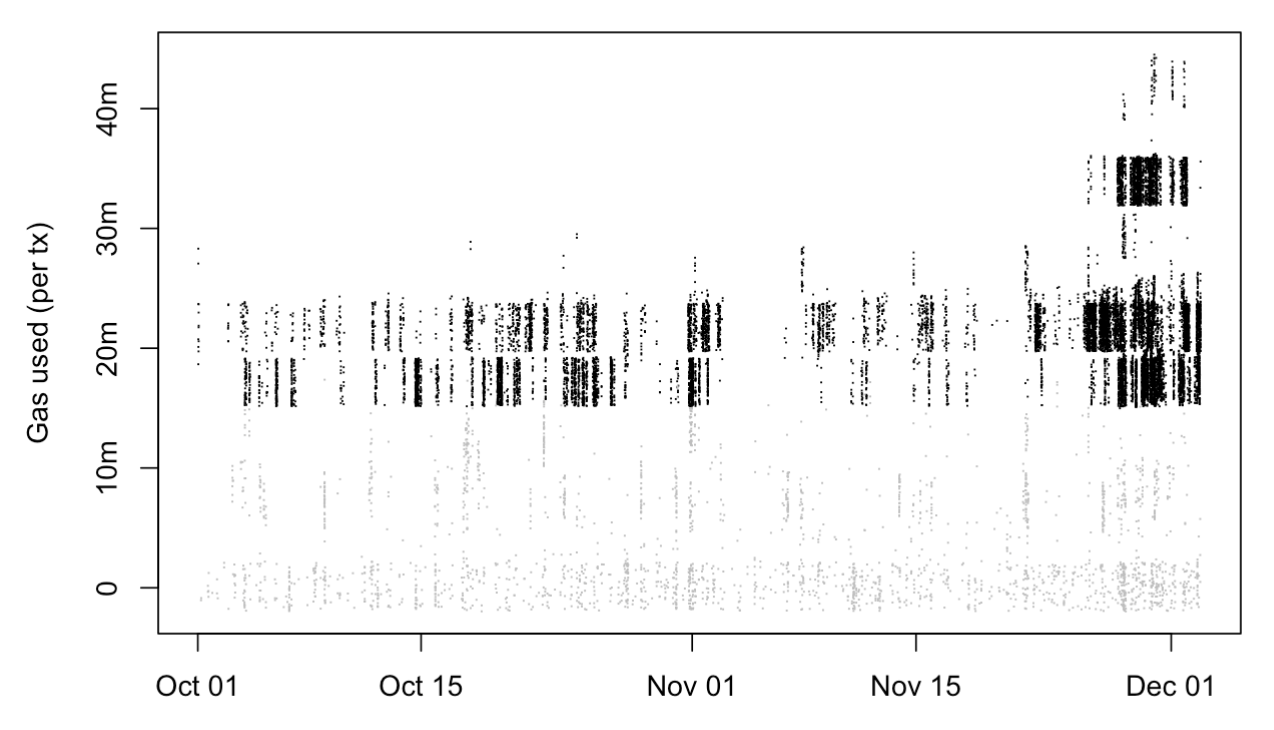
At least some of this activity was deliberate playfulness before the arrival of Fusaka. Some participants on the ledger were sharing notes about how to use the very low current base fee conditions to populate whole blocks. In this single transaction for example a method is called in such a way as to take up almost the entire block space.
Wanna break a block? Pull up 0x0000000000004FF483651151c796B2E851cd586e on Blockscout's Ethereum explorer, configure the bravo method with an _inputSize of 32 and _iterations of 37888, set 0.4 gas fee, and send it. Use Metamask smart accounts because most RPCs will reject it. https://t.co/mYuIcxtLGj
— zodomo.eth (🌍,💻) (@Zodomo) December 2, 2025
We checked if any future transactions from these addresses failed after Fusaka. This could indicate that these systems are automated bots and have not been adjusted for the per-transaction gas restriction that Fusaka introduces. In the addresses analyzed shown above, some of those failed transactions could be due to the sudden throttle from Fusaka.
iii. secp256r1 Integration
There are many EIPs implemented in Fusaka, and this Nov. 6th summary of Fusaka from the Ethereum Foundation offers an excellent summary of them all. I want to highlight one final update that would seem to merit its own headline status.
EIP-7951 is framed as an “improvement to UX.” It fully integrates a prominent authentication signature scheme into Ethereum with a precompiled contract. Precompiles are long-standing mechanisms to equip Ethereum with advanced cryptography or other computation for ease of developing applications.
EIP-7951 adds a precompiled system for a prominent signature scheme, known as secp256r1. This elliptic curve signature system is used widely across industry.

A summary for this precompile mentions that this signature scheme enables Apple enclave and Android support. This means EIP-7951 will now permit “device-native signing without seed phrases,” which could mean signing transactions natively with face ID on your cell phone. Along with Pectra’s account abstraction tools now available, this opens whole new vectors of mainstream adoption.
This secp256r1 scheme is already deployed on some L2s, but it brings L1 into alignment with these plans that could facilitate integration of the Ethereum ecosystem into countless electronic devices that use this signature scheme.
Conclusion
In the introduction to this post, I mentioned a tension in Ethereum’s scaling model, between compute and storage. A recent on-chain event illustrates this:
a place found.
— diid (@0xdiid) December 1, 2025
10.1 MB webm video
fully stored on-chain, Ethereum mainnet
some words 👇 pic.twitter.com/svRFdKM1ru
Just this past week the largest NFT ever stored on-chain was achieved by artist diid. A 10-megabyte video was uploaded to an NFT contract and required 191 transactions. Intriguingly, diid seems to have abided by the new per-transaction gas limit before Fusaka was released, keeping each “append” operation, which stitched the video data together, to about 16,171,465 gas (the new limit is 2²⁴ = 16,777,216).
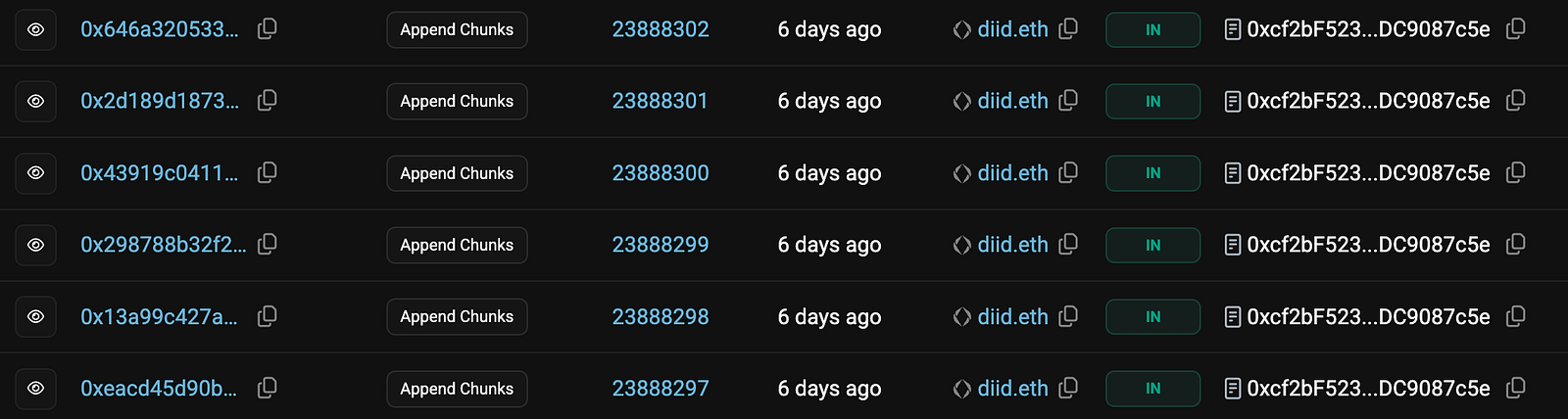
He also approximately abided by another Fusaka upgrade EIP-7934: Blocks are now limited to 10 megabytes. Like the per-transaction limit, this is a measure to avoid denial-of-service attacks or potential impacts of misuse of block space.
diid's video is alluring, mesmerizing in its visuals and audio. But this is a technical feat too. The interested reader can open up these transactions and look at how he is encoding the video — creating many contracts that successively hold and stitch back together the video data.
This technical accomplishment illustrates the cost model of Ethereum. Achieving storage like this is tricky. In Ethereum’s future, potentially preserving data on chain is going to be trickier too, especially as we reach more history and state pruning that future hard forks will introduce.
In Fusaka, we have a taste of this. Ethereum is greasing the wheels of transacting and computing to increase adoption at scale. Gas should be cheap. With account abstraction in Pectra, transacting can be readily made free for users ("gas sponsorship").
And with Fusaka, we can insert account abstraction onto integrated hardware used by massive commercial enterprise systems. Gas capacity is increasing, blob capacity is growing while managing data more carefully with sampling.
The future is exciting, a mass ecosystem that should be fast and easy to use. But it produces serious risks to decentralization and limits to participation as the state grows. The challenges of managing this resulting data of such a mass system will bring fun opportunities to see data as a very special resource worth paying for and preserving.
Fusaka’s mix of updates alongside diid’s data gymnastics illustrate the care we may take in the future this way. It presents new opportunities for creative solutions to the protocol’s constraints.
Some links
- Etherscan’s incredible API to harvest relevant transactions
- Thanks to Flipside for superb AI-based scans that combine beautifully with Etherscan API.
- diid’s “a place found” was included in an on-chain curation by SuperRare called “Intimate Systems.” This curation was special in integrating features of the public ledger that conclude this post.
—
Takens Theorem is on X. He was not paid for this post. He enjoyed writing it. He sometimes owns things he mentions, such as some ETH and such. Also: Takens had a creative piece included in the Intimate Systems collection mentioned above.