A block explorer is a search engine for blockchain data. It allows anyone to look up transactions, accounts, tokens, blocks, programs, and other activity recorded on a blockchain.
What Does a Block Explorer Do?
Every blockchain maintains a public record of its transactions and activity. However, this information is stored as technical network data rather than organized like a conventional website.
A block explorer indexes that data and connects related records so they can be searched using an account address, transaction signature, token mint address, block or slot number, program ID, or validator identity.
Using a Solana block explorer, you can confirm whether a transaction succeeded, inspect the assets held by an account, verify a token’s mint address, explore smart contract activity, and monitor network performance.
What Is Solscan?
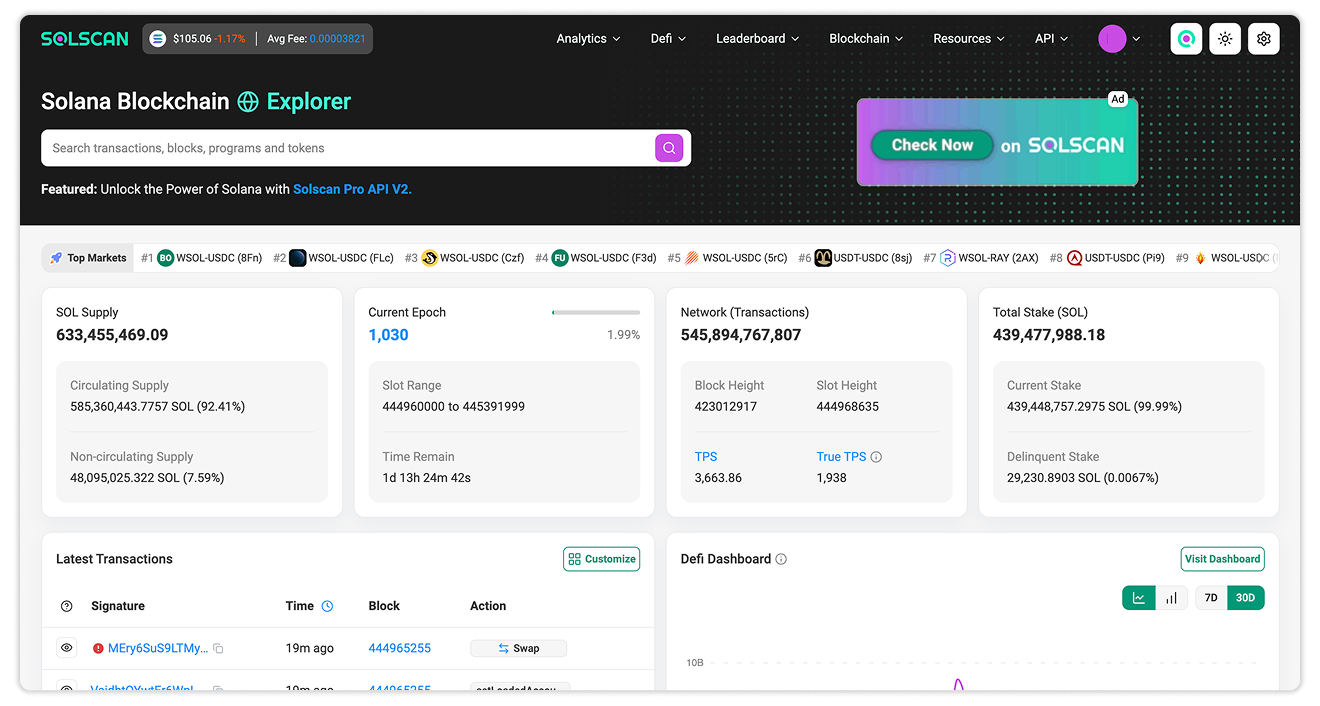
Solscan is a leading block explorer and data platform built for the Solana blockchain. It independently indexes Solana’s public on-chain data and makes it accessible through explorer pages, analytics dashboards, APIs, and developer tools.
Its services extend across several areas:
- Blockchain explorer: Search Solana accounts, transactions, tokens, blocks, programs, validators, and NFTs.
- Analytics and leaderboards: Monitor network activity, fees, stablecoins, tokens, DeFi markets, programs, and other ecosystem trends.
- Developer tools and APIs: Decode blockchain data, inspect program interactions, and integrate indexed Solana data into applications and analytics products.
- Explorer as a Service: Provide blockchain explorer infrastructure for supported networks and ecosystems.
Solscan is not a wallet, exchange, or custodian. It does not store private keys or control any of the transactions and assets displayed on the platform.
What Information Can You Find on a Block Explorer?
Account
An account is an addressable record on Solana. Depending on its purpose, an account may hold SOL, store tokens or data, or contain executable program code. In everyday use, people commonly search wallet addresses through an account page.
A Solscan account page provides an overview of an address’s SOL balance, token holdings, portfolio value, transactions, transfers, DeFi activity, NFTs, stake accounts, balance changes, and funding information. It can be used to review a wallet’s holdings, trace asset movements, or examine how an address interacts with Solana applications.
For a complete breakdown, see Exploring the Solscan Account Page.
Transaction
A Solana transaction contains one or more instructions submitted to the network. Each transaction has a unique signature that can be searched through a block explorer.
The transaction details page shows whether the transaction succeeded or failed, when it was processed, which accounts and programs were involved, and how SOL or token balances changed. More technical information—including instructions, inner instructions, program logs, fees, and compute units—is also available for deeper investigation.
Users can use this page to verify a transfer, while developers can examine how a transaction was executed or identify why it failed.
For more details, see Solscan Transaction Details.
Token
Tokens on Solana are identified by their mint addresses. A token page combines on-chain records with available metadata, holder data, market information, and activity.
On Solscan, this may include the token’s name, symbol, mint address, supply, authorities, number of holders, holder distribution, transfers, transactions, price, trading volume, liquidity, and DeFi activity.
Token names and symbols can be duplicated. The mint address is therefore the most reliable identifier when verifying whether a token is authentic.
For a detailed guide, see Exploring the Token Details Page.
Block and Slot
A block contains transactions recorded on the blockchain. On Solana, a slot is the period during which a validator may produce a block. Not every slot results in a completed block, so slot height and block height are related but not identical.
A block details page can show the block time, blockhash, parent slot, included transactions, transaction and instruction counts, block rewards, and validator context. This information is mainly useful for network monitoring, transaction tracing, and technical analysis.
Learn more in Exploring the Block Details Page.
Program
A program is executable code deployed on Solana—the equivalent of a smart contract on other blockchains. Programs power decentralized exchanges, lending protocols, staking platforms, marketplaces, games, and other applications.
A Solscan program page connects a program ID with its transactions, instructions, interacting accounts, deployment information, upgrade authority, IDL data, and verified source code or security information when available. Developers and researchers commonly use these pages to investigate program behavior and troubleshoot transactions.
See Exploring the Program Page for a complete walkthrough.
Validator and Staking
Validators process transactions, vote on the state of the network, and help secure Solana. Block explorers make validator and staking data easier to review by displaying information such as validator identity, vote account, activated stake, commission, current status, epoch performance, and delegation activity.
This information helps delegators and other network participants monitor validator operations and compare their on-chain performance.
NFT
NFT pages and account portfolios may display an NFT’s mint address, collection, current owner, creator information, metadata, attributes, transaction history, and marketplace activity.
Because NFT names, images, and metadata may come from external sources, the mint and collection addresses should be verified before relying on the displayed branding.
Who Uses a Block Explorer?
- Everyday users verify transactions, balances, transfers, and wallet activity.
- Traders and researchers analyze token holders, liquidity, fund movements, and DeFi activity.
- Developers inspect programs, instructions, logs, account data, and transaction errors.
- Projects and institutions monitor treasuries, program usage, counterparties, validators, and operational activity.
No special software or wallet connection is required to search public blockchain data.
Explore the Solana Blockchain with Solscan
A block explorer makes public blockchain records searchable and easier to understand. With Solscan, users can verify Solana transactions, explore wallet activity, inspect tokens and programs, analyze network data, and access developer-focused blockchain tools from one platform.
Start by entering an account address, transaction signature, token mint address, block, slot, or program ID at Solscan.io.